Polymarket Iran markets: invasion, leadership and nuclear-deal odds, and the controversies behind them
Polymarket has listed hundreds of markets on the 2026 Iran war, from ceasefires to who leads Iran. What they price today, why one was pulled and another ended up in a $100 million-plus dispute, the insider-trading worries, and why you will not find these markets on Kalshi.
In this article
Polymarket has become one of the busiest places to trade on Iran. Since US and Israeli strikes began the 2026 Iran war on 28 February, the international Polymarket site has listed hundreds of related markets, some with tens of millions of dollars traded. They have also produced some of the biggest controversies in the industry's history.
Prices as of 22 October 2026. These are probabilities set by traders, not forecasts by us. Markets on war involve real loss of life; we cover them because they are widely quoted and widely debated.
The background in brief
- 28 February 2026: US and Israeli strikes on Iran begin. Supreme Leader Ali Khamenei is killed on the first day; Iran confirms his death on 1 March.
- 8 March: the Assembly of Experts names his son, Mojtaba Khamenei, as Supreme Leader. He was injured in the strike and has rarely been seen in public since.
- 8 April: a two-week ceasefire mediated by Pakistan takes effect; it is later extended.
- Mid-June: the US and Iran agree a memorandum of understanding, signed on 17 June, setting a 60-day window to negotiate a final deal.
- July–August: the truce breaks down over attacks on shipping in the Strait of Hormuz, and the memorandum expires in August.
- October: indirect talks through mediators continue. President Trump has said US military action could resume after the midterms if there is no satisfactory agreement.
What Polymarket prices today
| Market | Price | Traded |
|---|---|---|
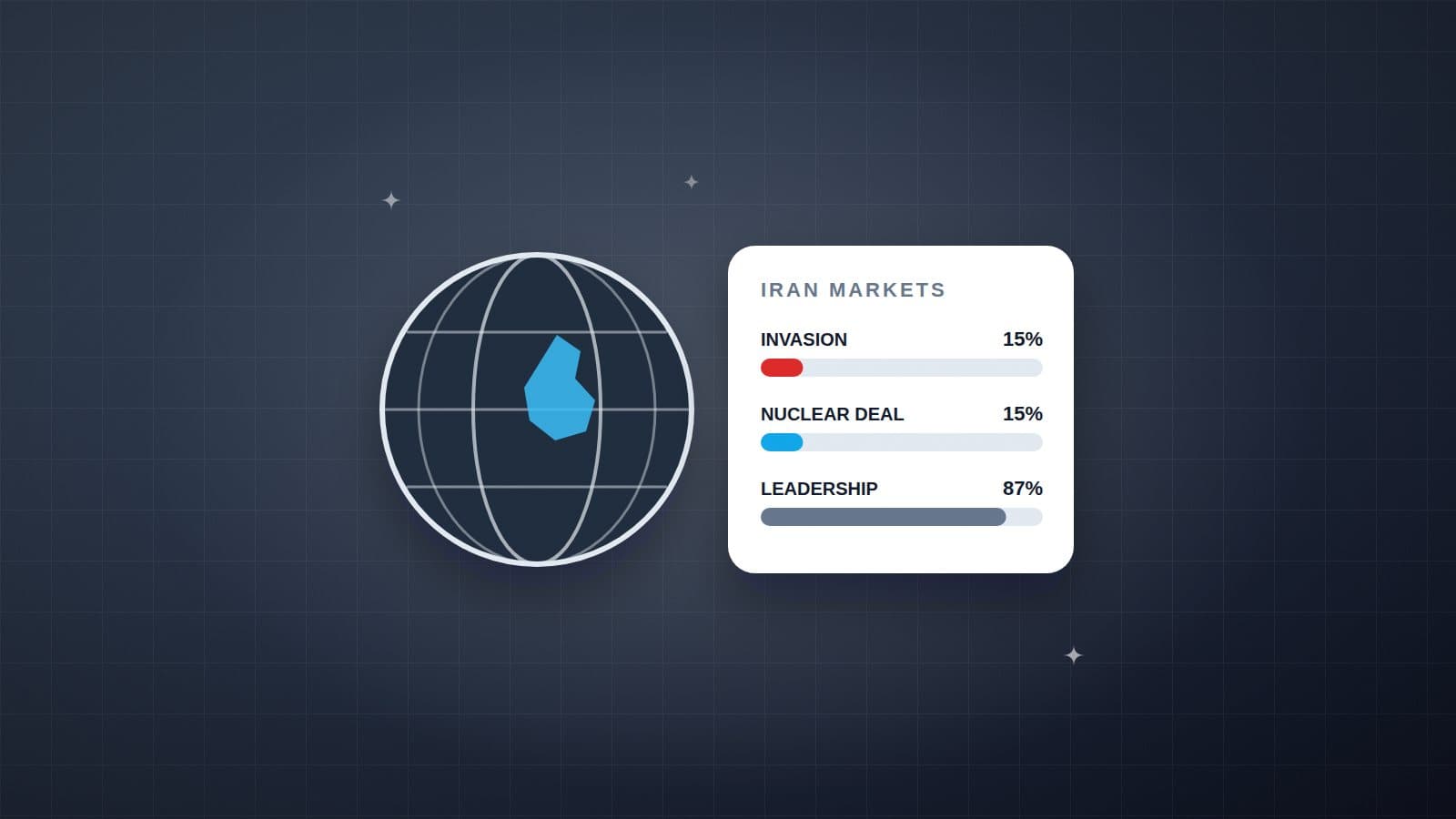
| Will the US invade Iran before 2027? | 15.5% yes | About $75 million |
| Iran's leader at the end of 2026: Mojtaba Khamenei | 87% | About $40 million |
| Iran leadership change by 30 June 2027 | 23.5% | About $28 million |
| US–Iran final nuclear deal by 31 December | 14.5% | About $20 million |
| Iran agrees to surrender its enriched-uranium stockpile by 31 December | 5.5% | About $18 million |
| US–Iran ceasefire continues through the midterms | 71.5% | About $1 million |
Read each market's rules before trusting a headline number. "Ceasefire", "invasion" and "deal" are defined precisely, and the definition, not the news coverage, decides the payout (how markets resolve). Two invasion markets with different wording can trade at very different prices.
The controversies
A market that was pulled. In April, after a US F-15E was shot down over Iran, Polymarket listed a market on when the US would confirm the rescue of the two airmen. After a backlash, including from Representative Seth Moulton, it removed the market on 5 April, saying it did not meet its integrity standards and should not have been posted.
A $100 million-plus dispute over the word "permanent". A market on whether the US and Iran would reach a permanent peace deal drew well over $100 million. Critics argued the June memorandum was interim, since it set up 60 days of further talks; supporters pointed to the announcements by both governments. The question went to a vote of UMA token holders, Polymarket's resolution mechanism, where early reporting showed overwhelming support for "yes". Some losing traders threatened legal action, and critics said the episode showed how much power a small group of token holders can have over a very large market (UMA explained).
Pressure on journalists. Around a strike-related market with more than $17 million at stake, journalists reported threats from people trying to change their coverage. Polymarket said it banned the accounts involved and would pass information to authorities.
Insider trading. War markets are exactly where someone with classified or operational knowledge could profit. In a separate case, a US Army soldier was charged over trades based on classified information about the capture of Nicolás Maduro, described as the first known criminal prosecution of insider trading on a prediction market in the US. Polymarket's large, early price moves before some Iran headlines have drawn similar suspicion. Congressional Democrats have introduced legislation to ban contracts tied to elections, war and government actions.
Why these markets are not on Kalshi
US rules bar regulated exchanges from listing contracts that involve war, terrorism or assassination (CFTC rule 40.11). That is why Kalshi and Polymarket's US app do not carry markets like these. They trade on Polymarket's international site, which does not accept US residents (is Polymarket legal in the US?). If you are in the US, the regulated alternatives are economic markets that react to the war, such as oil, inflation and the Fed.
How to read Iran odds
- Thin markets mislead. A dramatic price on a market with a few thousand dollars traded means little. Check volume and the bid–ask spread (slippage and spread).
- Deadlines matter. "By 31 October" and "by 31 December" are different questions; the closer deadline is almost always cheaper.
- Prices react to statements. Many of the biggest moves have followed posts by officials, not events on the ground.
Polymarket Iran: frequently asked questions
Does Polymarket have markets on Iran?
Yes, on its international site: ceasefires, an invasion, Iran's leadership, a nuclear deal and more.
What are the odds the US invades Iran before 2027?
About 15.5% on Polymarket as of 22 October 2026.
Who leads Iran?
Mojtaba Khamenei was named Supreme Leader on 8 March 2026; Polymarket gives about 87% that he is still leader at the end of 2026.
Why did Polymarket remove an Iran market?
In April it pulled a market on the rescue of two US airmen, saying it did not meet its integrity standards.
Can Americans trade Polymarket's Iran markets?
No. They are on the international site, which does not accept US residents, and US-regulated exchanges cannot list war contracts.