Kalshi fees explained (2026): the fee formula, maker fees, deposits and how to pay less
Kalshi charges takers 7% × price × (1 − price) per contract, rounded up to the cent: at most 1.75¢ at 50¢. Makers pay a quarter of that on some markets, settlement is free, bank transfers cost nothing and cards about 2%. A fee table, worked examples and how to cut costs.
In this article
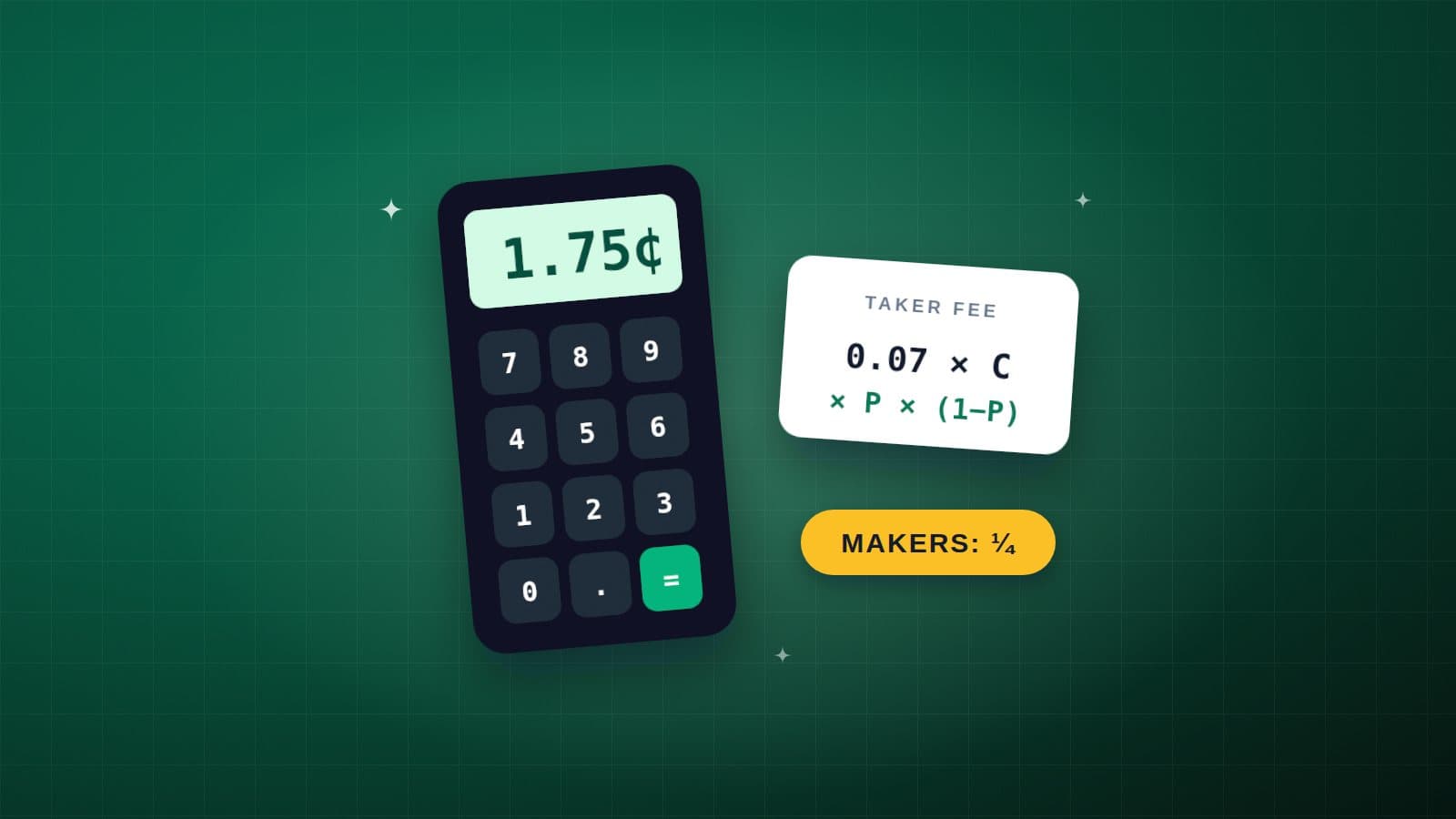
Kalshi makes its money from a trading fee charged when your order fills. Takers, orders that match straight away, pay 7% × contracts × price × (1 − price), rounded up to the next cent. That peaks at 1.75¢ per contract at 50¢ and falls towards zero near 1¢ and 99¢. Resting limit orders pay a quarter of that on markets with maker fees, and nothing elsewhere. There is no fee to cancel an order, to hold a position or to settle one.
As of October 2026, from Kalshi's published fee schedule as reported by its help centre and fee trackers. The order ticket shows the exact fee before you confirm.
Kalshi fees at a glance
| Cost | What you pay |
|---|---|
| Taker fee | 0.07 × contracts × P × (1 − P), rounded up to the cent |
| Maker fee | 0.0175 × contracts × P × (1 − P) on markets with maker fees; otherwise nothing |
| Cancelling an order | Free |
| Settlement | Free; a winning contract pays $1 |
| Bank transfer (ACH) | Free, both ways |
| Debit card deposit | Up to about 2% |
| Wire deposit | No Kalshi fee; from $1,000; your bank may charge |
| Interest you earn | 3.50% APY on cash and positions (variable) |
How the fee formula works
P is the contract price in dollars, so a 30¢ contract is 0.30. P × (1 − P) is largest at 50¢ (0.25) and small near the edges (0.09 at 10¢ or 90¢), which means a 30¢ trade costs the same in dollars as a 70¢ one.
| Price | Fee per contract | 10 contracts | 100 contracts | Share of your cost |
|---|---|---|---|---|
| 5¢ | 0.33¢ | $0.04 | $0.34 | 6.7% |
| 10¢ | 0.63¢ | $0.07 | $0.63 | 6.3% |
| 25¢ | 1.31¢ | $0.14 | $1.32 | 5.3% |
| 50¢ | 1.75¢ | $0.18 | $1.75 | 3.5% |
| 75¢ | 1.31¢ | $0.14 | $1.32 | 1.8% |
| 90¢ | 0.63¢ | $0.07 | $0.63 | 0.7% |
| 95¢ | 0.33¢ | $0.04 | $0.34 | 0.35% |
In dollars the fee is symmetric. As a share of what you pay it is not: the fee divided by the price is 7% × (1 − P), so cheap long shots carry the heaviest fee load.
Source: PredictDesk calculation from Kalshi’s fee formula
Show the dataHide the data
| Value | |
|---|---|
| 5¢ | 6.7% |
| 10¢ | 6.3% |
| 25¢ | 5.3% |
| 50¢ | 3.5% |
| 75¢ | 1.8% |
| 90¢ | 0.7% |
| 95¢ | 0.4% |
Why small orders pay more
Fees round up to the next cent per order, so tiny orders pay for a sliver of a cent they did not use. At 10¢, one contract pays a full cent, 59% more than the 0.63¢ the formula says.
Source: PredictDesk calculation from Kalshi’s fee formula
Show the dataHide the data
| Value | |
|---|---|
| 1 contract | 1.00¢ |
| 5 contracts | 0.80¢ |
| 10 contracts | 0.70¢ |
| 100 contracts | 0.63¢ |
Maker fees
A maker order rests on the book until someone trades against it. On markets where Kalshi charges maker fees, the rate is 0.0175, a quarter of the taker rate: 100 contracts at 50¢ cost $0.44 instead of $1.75. Many markets charge makers nothing. Either way, the fee is charged only when the order fills; cancelling is free. Kalshi also runs liquidity incentive programs on selected markets (limit order vs market order).
Markets with different rates
Kalshi's help centre notes that some markets carry different fees, often around special events, and fee trackers report that the schedule gives S&P 500 and Nasdaq-100 markets half the usual rate (0.035). The fee line on the order ticket is the one to trust.
Worked examples
- A $100 coin flip. 200 contracts at 50¢ as a taker: 0.07 × 200 × 0.5 × 0.5 = $3.50. If you win you collect $200, with no fee on settlement: a profit of $96.50.
- A heavy favourite. 1,000 contracts at 90¢: 0.07 × 1,000 × 0.9 × 0.1 = $6.30 on a $900 stake, just 0.7%.
- The same coin flip as a maker. 200 contracts at 50¢ resting on the book: 0.0175 × 200 × 0.25 = $0.875, rounded up to $0.88, or $0 on markets without maker fees.
- Selling before settlement. Selling is another trade, so a market order to sell pays the taker fee again. Holding to settlement costs nothing (how Kalshi payouts work).
Deposits, withdrawals and interest
| Method | Deposit | Withdrawal |
|---|---|---|
| Bank transfer (ACH) | Free; $10 minimum | Free; 1–3 business days |
| Debit card | Up to about 2% | Usually within hours |
| Wire | From $1,000; no Kalshi fee | Same or next business day; flat fee |
| Crypto | Network and processor fees | Often within an hour |
Kalshi also pays 3.50% APY on cash and open positions for eligible US users with an average monthly balance of at least $250, which offsets fees on long-dated trades (withdrawals on Kalshi and Polymarket).
Kalshi vs Polymarket fees
| Taker fee on 100 contracts at 50¢ | |
|---|---|
| Kalshi | $1.75 |
| Polymarket US (since 19 October 2026) | $1.74 |
| Polymarket global site | $1.00 (politics) to $1.75 (crypto); $0 on geopolitics |
Polymarket makers pay nothing on either platform, while Kalshi charges makers on some markets (Polymarket fees explained; the full comparison).
How to pay less on Kalshi
- Use limit orders. You pay the maker rate or nothing, and you avoid crossing the spread.
- Place fewer, larger orders. Rounding up per order punishes tiny ones.
- Avoid market orders on long shots, where the fee is the biggest share of the stake.
- Fund by bank transfer, not card.
- Hold to settlement when your view has not changed: settling is free, selling is a trade.
Kalshi fees: frequently asked questions
How much does Kalshi charge per trade?
Takers pay 7% × contracts × price × (1 − price), rounded up to the cent: at most 1.75¢ per contract, at 50¢.
Does Kalshi charge maker fees?
On some markets, at a quarter of the taker rate (0.0175), and only when the order fills.
Does Kalshi charge a fee on winnings?
No. Settlement is free; fees are charged when you trade.
Does Kalshi charge to deposit or withdraw?
Bank transfers are free. Debit card deposits cost up to about 2%.
How much is the Kalshi fee on a $100 bet?
At 50¢ (200 contracts), $3.50 as a taker. At 90¢ (about 111 contracts), about $0.70.