Kalshi review 2026: fees, markets, the app, payouts and whether it is worth using
An honest Kalshi review for October 2026: how the CFTC-regulated exchange works, what it costs (up to 1.75¢ a contract), the 3.50% APY, deposits and withdrawals, the app, the state fights over sports contracts, the mention-market controversies and who it suits.
In this article
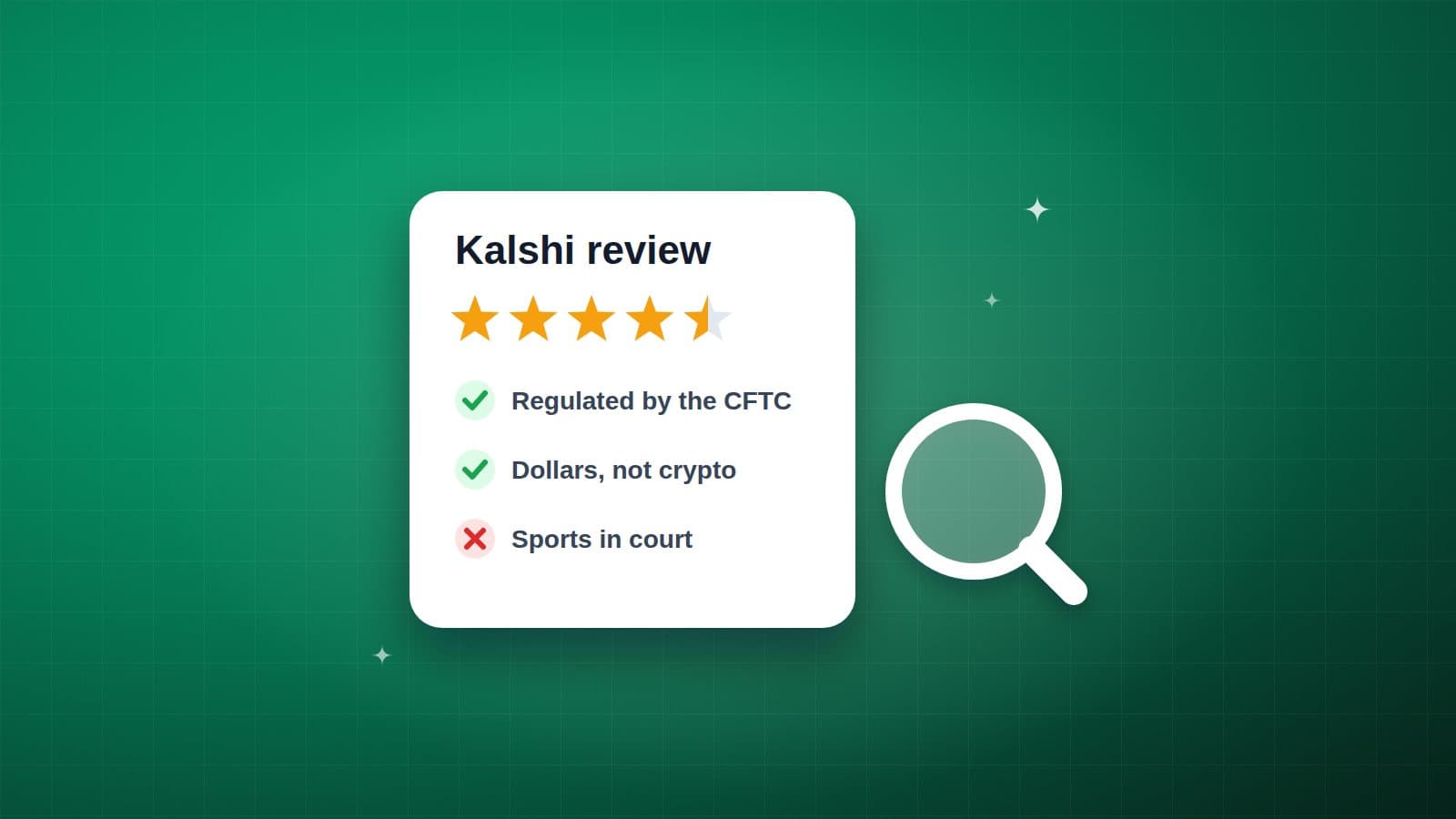
Kalshi is a legitimate, CFTC-regulated exchange and the biggest prediction market in the United States. It is the easiest way for Americans to trade on sports, economics, weather and politics with dollars from a bank account, and it pays interest on idle money. The downsides are real but specific: fees on market orders, sports contracts tangled up in state lawsuits, and a support and verification process that frustrates a minority of users.
Reviewed in October 2026 from Kalshi's help pages, its fee schedule, court and regulatory records and our own use. Rates and availability change; the app shows the current ones.
Kalshi at a glance
| What it is | An exchange for event contracts that pay $1 if an outcome happens |
| Regulator | CFTC; a designated contract market since 2020 |
| Founded | 2018, by Tarek Mansour and Luana Lopes Lara |
| Who can use it | US residents aged 18+ (age rules) |
| Markets | Sports, politics, economics, weather, crypto, culture, mentions |
| Trading fee | 7% × price × (1 − price) per contract, at most 1.75¢ |
| Interest | 3.50% APY on cash and positions (variable) |
| Deposits | Bank transfer, debit card, wire, crypto |
| App | About 4.8 stars from 620,000+ App Store ratings |
| Valuation | $22 billion at its last confirmed round (who owns Kalshi) |
Our scorecard
Source: PredictDesk editorial ratings
Show the dataHide the data
| Value | |
|---|---|
| Regulation and safety | 9.5/10 |
| Range of markets | 9.0/10 |
| App and ease of use | 9.0/10 |
| Deposits and withdrawals | 7.5/10 |
| Fees | 7.0/10 |
| Support and disputes | 6.0/10 |
What Kalshi does well
- It is regulated like a futures exchange. Customer money is held separately from the company's, trades are surveilled, and the CFTC can and does act on abuse. When a White House teleprompter operator traded on speeches he had seen in advance, Kalshi's surveillance flagged it and the CFTC fined him (is Kalshi legit?).
- Dollars, not crypto. You fund it from a bank account or card like a brokerage app.
- Deep sports markets. Sports are most of its volume, so spreads on big games are tight (sports prediction markets).
- Markets other platforms lack. Fed decisions, CPI prints, temperatures in a dozen cities, box office and chart positions.
- Interest on your balance. Kalshi pays a variable APY on cash and the money tied up in open positions, which makes long-dated trades less costly to hold.
Where Kalshi falls short
- Market orders are not cheap. Paying 1.75¢ on a 50¢ contract is 3.5% of the stake; on a long shot the fee is a bigger share still. Limit orders cut the cost.
- Sports contracts are in legal limbo. States say they are unlicensed sports betting. Courts have split, Kalshi blocks some contracts in some states, and its chief executive says the fight could end up at the Supreme Court (Kalshi and the Supreme Court).
- Verification and withdrawal complaints. App store ratings are high, but review sites such as Trustpilot carry a steady stream of complaints about identity checks taking weeks and withdrawals being held. Most concern first withdrawals and bank holds, which are normal but poorly explained.
- Contested resolutions. Kalshi settles on the letter of each market's rules, which has produced angry disputes, especially in mention markets (mention markets explained).
- Credits are not cash. Promotional credit must be traded; it cannot be withdrawn (Kalshi sign-up bonus).
Kalshi fees
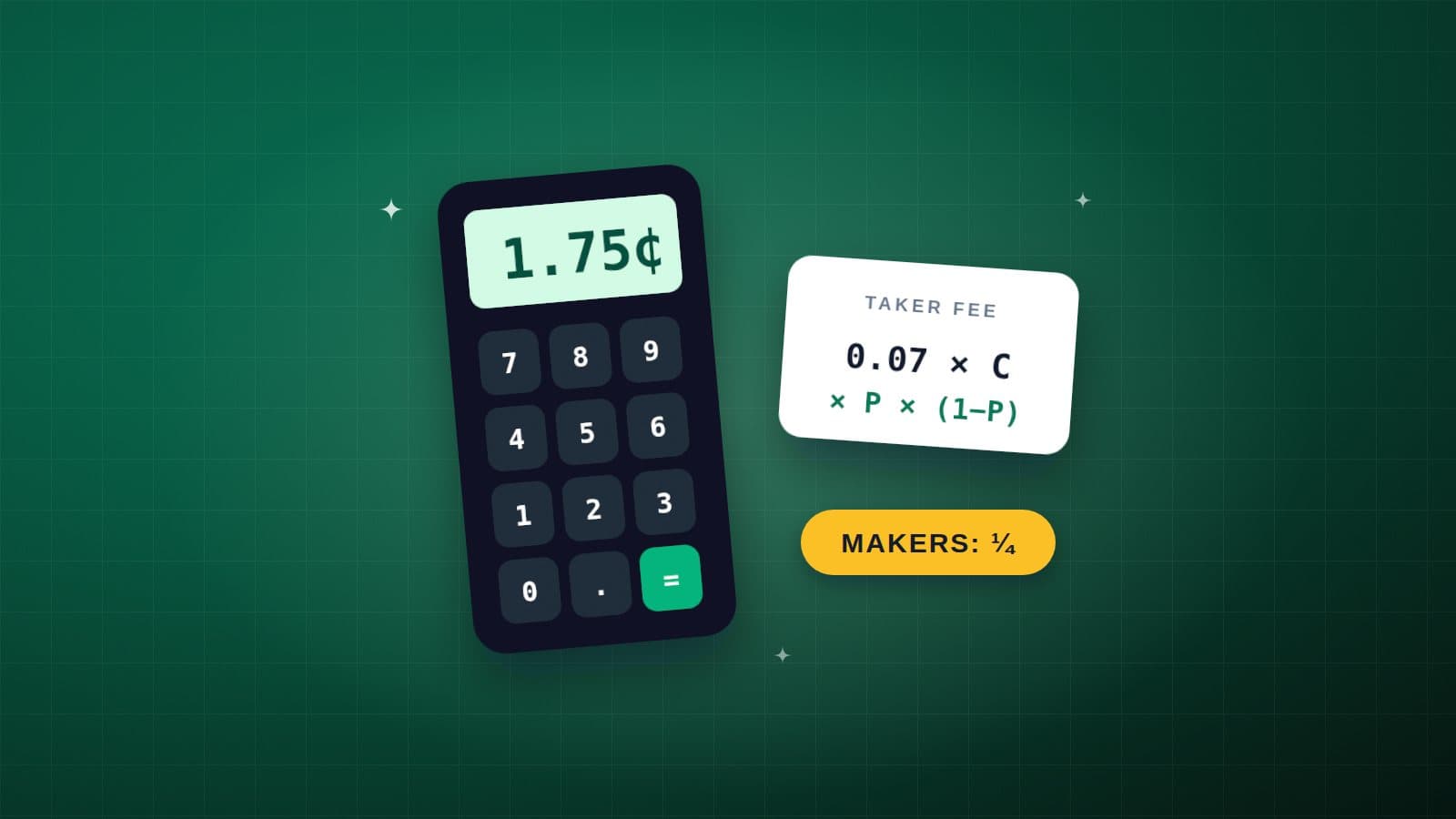
Kalshi charges takers, orders that fill immediately, a fee of 7% × contracts × price × (1 − price), rounded up to the cent per order. Makers, resting limit orders, pay a quarter of that on markets where maker fees apply, and nothing if the order is cancelled. There is no fee to settle or to hold a position.
| Price | Taker fee, 100 contracts | Maker fee, 100 contracts (where charged) |
|---|---|---|
| 10¢ | $0.63 | $0.16 |
| 25¢ | $1.32 | $0.33 |
| 50¢ | $1.75 | $0.44 |
| 75¢ | $1.32 | $0.33 |
| 90¢ | $0.63 | $0.16 |
Some markets, often tied to special events, use different rates; the order ticket shows the exact fee before you confirm. The full schedule is in Kalshi fees explained, and how Kalshi compares with Polymarket in Polymarket fees vs Kalshi fees.
Interest: 3.50% APY
Kalshi's help centre lists a 3.50% APY, variable and changeable at any time. The details:
- It applies to cash and open positions, including the collateral behind them.
- Your average monthly balance must be at least $250.
- Interest accrues daily on your net portfolio value at midnight Eastern time and is paid monthly.
- It is for eligible users in the US and its territories; you must give your Social Security number to receive more than $10 a year.
On $2,000 held all year, that is about $70. It does not change whether a trade is good, but it removes much of the cost of tying money up in a market that settles in a year or two.
Deposits and withdrawals
| Method | Deposit | Withdrawal |
|---|---|---|
| Bank transfer (ACH) | Free; $10 minimum | Free; 1–3 business days |
| Debit card | About 2% | Usually within hours |
| Wire | From $1,000; your bank's fees | Same or next business day |
| Crypto | Network fee | Often within an hour |
A deposit has to clear before that money can be withdrawn, which is the most common reason a first withdrawal is "stuck". Kalshi pays out only to accounts in your own name (withdrawals on Kalshi and Polymarket).
The Kalshi app
The app is where most people use Kalshi: about 4.8 stars from more than 620,000 ratings on the App Store, with a near-identical Android version. Search, a watchlist, live sports prices, parlays and a simple order ticket that hides the order book unless you want it (Kalshi app review).
Is Kalshi safe?
Safe in the sense that matters most: it is a regulated exchange, not an offshore site, and your money is not lent out or mixed with the company's. That does not make trading safe: most contracts are close to fair prices, so the average trader loses roughly the fees. Two practical risks are worth knowing:
- Insider and manipulation cases exist but are policed. On 28 August 2026 the CFTC ordered the teleprompter operator, Gabriel Perez, to pay a $65,000 penalty and give up $107,539 in profits, and banned him from trading for three years (insider trading on prediction markets).
- Rules decide disputes. Read a market's rules before trading anything unusual (how markets resolve).
Where Kalshi works
Kalshi is legal at the federal level and available to adults across the US. Sports contracts are the exception: Nevada, Massachusetts and others have won orders against them, the Sixth Circuit let Ohio and Tennessee enforce their gambling laws, and Washington blocks event contracts after a state court order. Kalshi's app shows what is available at your location (is Kalshi legal in your state?).
Kalshi vs Polymarket
| Kalshi | Polymarket | |
|---|---|---|
| For US users | Yes | Polymarket US app; the global site is not for the US |
| Money | Dollars | Dollars on Polymarket US; pUSD on the global site |
| Taker fee at 50¢ | 1.75¢ | 1.74¢ on Polymarket US; 1–1.75¢ on the global site |
| Interest or rewards | 3.50% APY | Holding rewards on selected long-dated markets |
| Strongest in | US sports, economics, weather | World politics, crypto, geopolitics |
The full comparison is in Kalshi vs Polymarket.
Who Kalshi suits
- Good fit: US residents who want regulated, dollar-based trading on sports, the economy or elections; anyone who will use limit orders; long-term holders who value the interest.
- Poor fit: people outside the US; anyone in a state that blocks the markets they want; traders who mainly want world politics or crypto, where Polymarket is usually deeper.
Verdict
Kalshi is the most complete regulated prediction market in the US in 2026. Use limit orders, read the rules on anything that settles on a single person's words or actions, and expect your first withdrawal to take a few days. If you do that, the main risk left is the one every trader takes: being wrong about the outcome.
Kalshi review: frequently asked questions
Is Kalshi legit?
Yes. It is a CFTC-regulated exchange that has operated since 2021.
Is Kalshi worth it?
For US residents who want regulated event trading, yes, especially with limit orders and the 3.50% APY. It is not a way to make easy money: fees and fair prices work against casual traders.
What are Kalshi's fees?
Takers pay 7% × price × (1 − price) per contract, at most 1.75¢ at 50¢. Makers pay a quarter of that where maker fees apply.
Does Kalshi pay interest?
Yes: 3.50% APY at the time of writing, on cash and positions, with a $250 average monthly balance.
How long do Kalshi withdrawals take?
Bank transfers take 1–3 business days; debit card payouts usually arrive within hours.
Why are some Kalshi reviews negative?
Most complaints are about identity verification delays, held first withdrawals and disputed market resolutions.