Polymarket fees vs Kalshi fees: what you actually pay (2026)
Both platforms now charge taker fees shaped by price × (1 − price). Worked examples at 10¢, 50¢ and 90¢, maker rebates, deposit and withdrawal costs, and how to pay less.
In this article
Until 2025 the answer was simple: Kalshi charged fees and Polymarket mostly did not. In 2026 both charge taker fees, and both use the same shape of formula, so the real comparison is about the rate on the market you trade and how you place orders.
Fee schedules change. These are the published structures as of October 2026; check each platform's fee page before trading.
The formula both platforms use
fee per contract = rate × price × (1 − price)
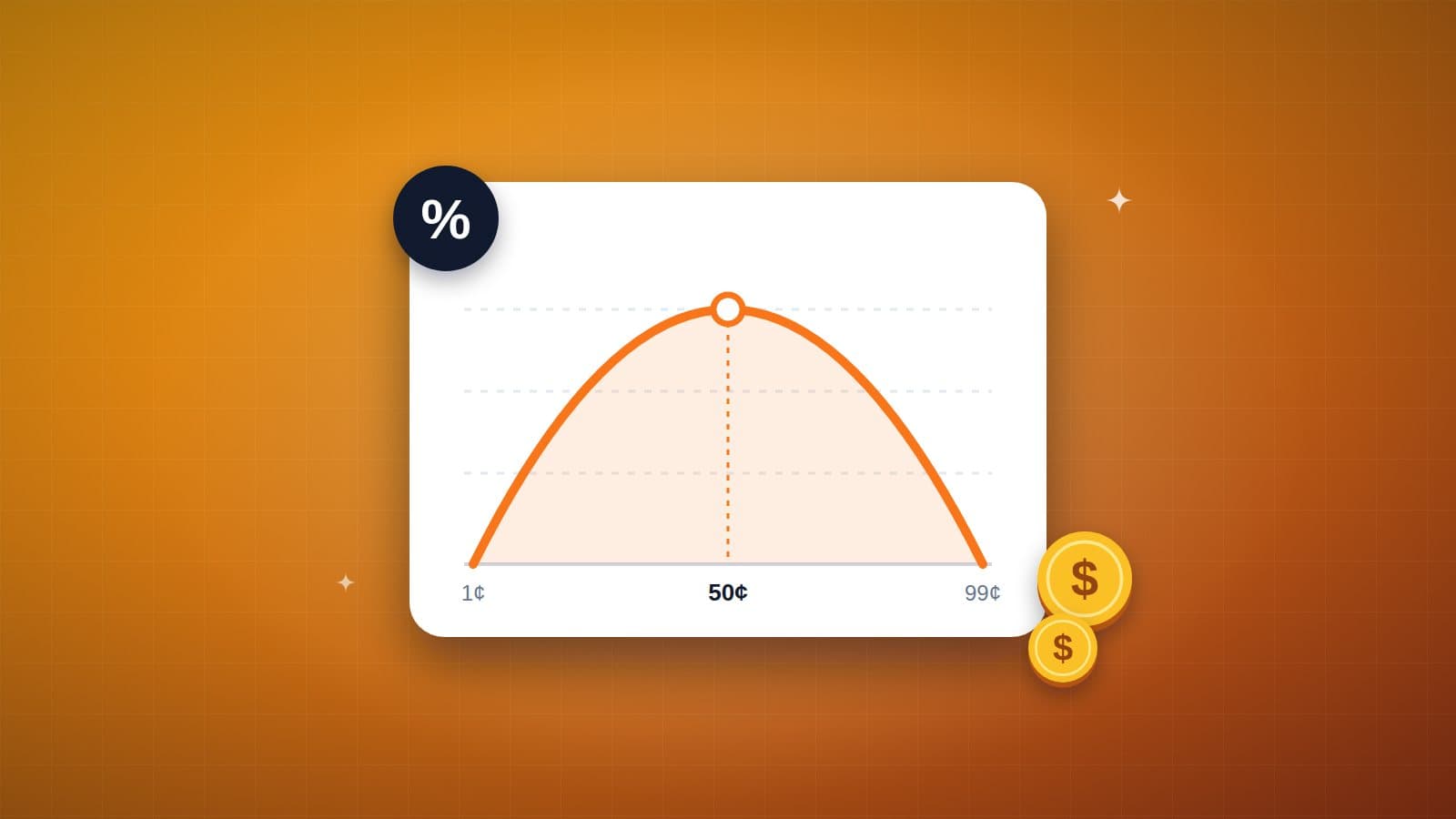
Price is in dollars (50¢ = 0.50). The term price × (1 − price) peaks at 50¢ and falls toward 1¢ and 99¢, so fees are highest on coin-flip markets and small on near-certain ones.
Kalshi fees
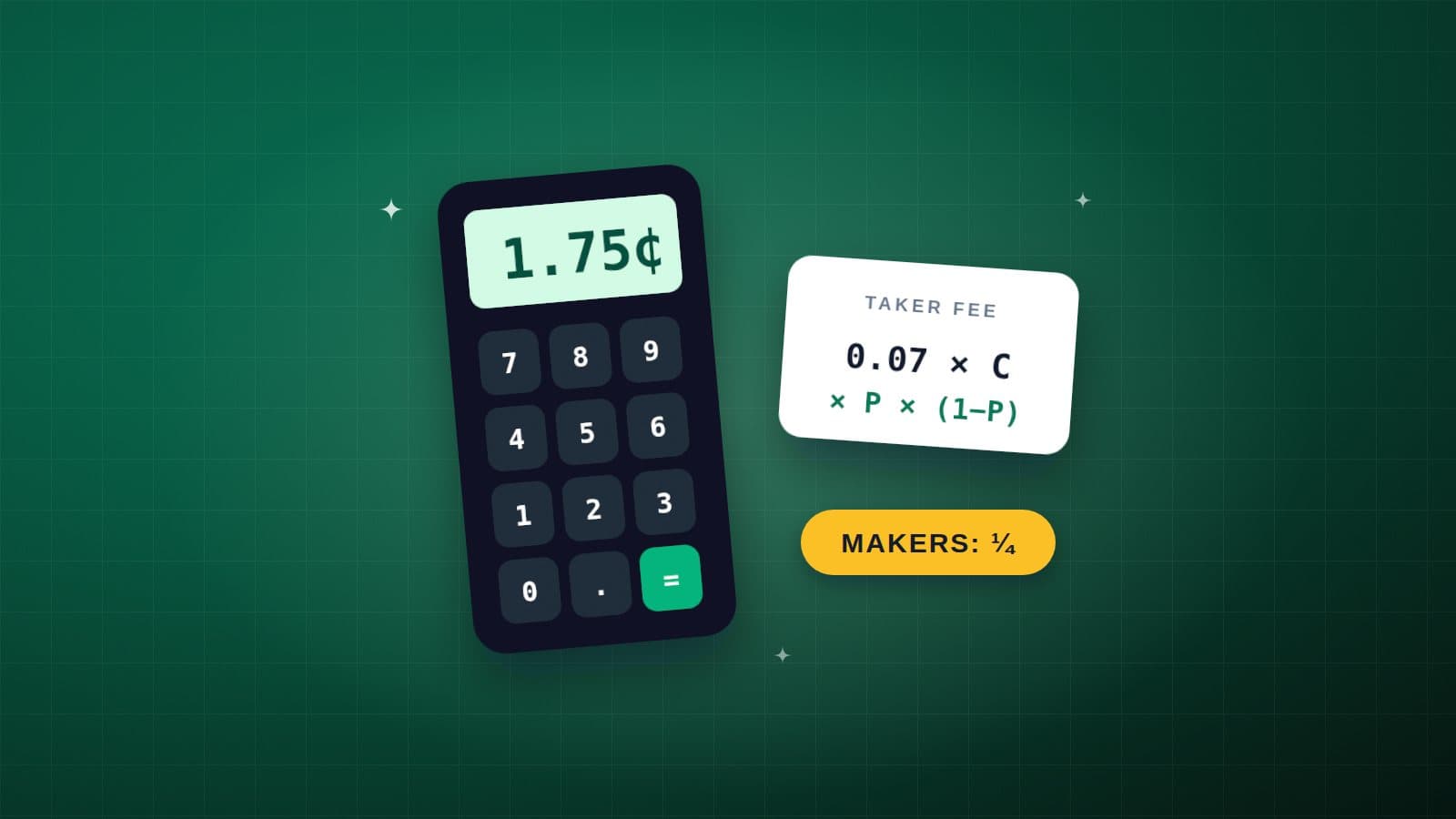
- Takers: 7% × contracts × P × (1 − P), rounded up to the next cent per order.
- Makers (resting limit orders, on markets with maker fees): a quarter of the taker rate, charged only when the order fills.
- No fee to cancel an order or for contracts that settle.
The full schedule, with a fee table and the rounding rule, is in Kalshi fees explained.
Polymarket fees
- Global site, takers: a category rate × shares × P × (1 − P). Crypto markets have the highest rate; finance, politics and tech are lower; geopolitics and world events are free.
- Global site, makers: no fee, plus rebates funded from taker fees.
- Polymarket US: since 19 October 2026, takers pay 0.0695 × contracts × P × (1 − P), or $1.74 per 100 contracts at 50¢, makers pay nothing, and active traders get volume rebates (Polymarket fees explained).
- Gas: on the global site Polymarket covers network fees for trading; moving USDC on and off exchanges can cost a little. Balances are held in pUSD and converted back to USDC when you withdraw.
Worked example: 100 contracts as a taker
| Price | Kalshi (7%) | Polymarket at a 4% category rate | Polymarket, world events |
|---|---|---|---|
| 10¢ | $0.63 | $0.36 | $0 |
| 50¢ | $1.75 | $1.00 | $0 |
| 90¢ | $0.63 | $0.36 | $0 |
On the same market, a lower category rate makes Polymarket cheaper to take liquidity, while posting limit orders is cheapest on both: Kalshi's maker rate is a quarter of its taker rate, and Polymarket makers pay nothing.
Deposits and withdrawals
- Kalshi: bank transfers (ACH) are free; debit card deposits carry a processing fee; withdrawals by ACH are free.
- Polymarket US: dollar deposits and withdrawals in the app.
- Global Polymarket: you deposit USDC, trade in pUSD (backed 1:1 by USDC) and withdraw USDC. The cost is mostly the exchange or on-ramp you use to buy and cash out USDC.
How fees eat into "free money"
Fees matter most when you are chasing small edges. If the same outcome is 3 points cheaper on one platform, two taker fees around 50¢ can take more than half of that gap. That is why our spread scanner shows the edge after fees, and why most gaps are not arbitrage (why, in detail).
Five ways to pay less
- Use limit orders instead of market orders. You pay maker rates (or nothing) and avoid crossing the spread.
- Trade fewer, larger orders on Kalshi: fees round up per order, so tiny orders pay proportionally more.
- Mind the price: fees are highest around 50¢.
- Compare both platforms before buying: a lower price can outweigh a higher fee. Our Compare page has a fee calculator.
- Hold to settlement when it makes sense: settling does not cost a fee, selling early does.
Fees: frequently asked questions
Does Polymarket charge fees?
Yes, since 2026 on most categories: takers pay a category rate × price × (1 − price). Makers pay nothing, and geopolitics and world-events markets are free.
How much is the Kalshi fee on a $100 trade?
At 50¢ (200 contracts), the taker fee is 7% × 200 × 0.5 × 0.5 = $3.50. At 90¢ (about 111 contracts) it is about $0.70.
Are there fees to withdraw?
Kalshi bank withdrawals are free. On global Polymarket, the cost is mostly the exchange you use to turn USDC into dollars.
Is there a fee if my contract wins?
No. Settlement is free on both platforms; fees are charged when you trade.