Insider trading on Kalshi and Polymarket: the cases, the rules and the 2026 crackdown
A soldier charged over Maduro bets, a Google engineer, George Santos, congressional candidates betting on themselves: 2026 made insider trading the biggest problem in prediction markets. Every major case, what the rules say, how Kalshi and Polymarket police it, and what Congress wants, with charts.
In this article
- The cases at a glance
- Case study: the Maduro bets
- The scale: how many cases?
- Why insiders are drawn to prediction markets
- What counts as insider trading on a prediction market?
- What the law says
- How Kalshi polices it
- How Polymarket polices it
- What Congress and regulators want
- What it means for regular traders
- Insider trading on prediction markets: frequently asked questions
- Keep reading
Insider trading became the biggest scandal in prediction markets in 2026. Federal prosecutors charged a US Army special forces soldier with using classified information to bet on the capture of Nicolás Maduro, and a Google engineer with trading on company data. George Santos was fined over a bet on his own behaviour. Kalshi suspended congressional candidates who bet on their own races. Between them, Kalshi and Polymarket have reportedly flagged more than 140 suspected insider traders to regulators this year, and Congress has opened an investigation.
This guide covers every major case, what counts as insider trading on a prediction market, how each platform polices it, and what lawmakers want to change.
As of 22 October 2026. Charges are allegations until proven in court.
The cases at a glance
| When | Who | Platform | What happened |
|---|---|---|---|
| 3 January 2026 | Polymarket traders | Polymarket | Bets that Maduro would be out of power paid off when US forces captured him, after unusual buying overnight |
| February 2026 | An editor for YouTuber MrBeast | Kalshi | Kalshi closed an account it said had a near-perfect trading record and reported the case to the CFTC; MrBeast later fired the editor |
| February 2026 | George Santos | Kalshi | Bet on whether he would attend the State of the Union; Kalshi referred him to authorities and he was fined $35,000 |
| April 2026 | Three congressional candidates | Kalshi | Fined and suspended for betting on their own campaigns; a fourth followed in August, with bans of three to five years |
| April 2026 | A US Army special forces soldier | Polymarket | Charged by the Justice Department with using classified information about the Maduro operation to bet |
| May 2026 | A Google software engineer | Polymarket | Charged with using access to company information to trade markets about search results |
Case study: the Maduro bets
The most serious case so far started with a market most traders thought was a long shot. Polymarket's "Maduro out by January 31, 2026?" traded at about 6% through 2 January. Here is what happened next, hour by hour:
Source: Polymarket price history (hourly, UTC); one hour without trades is left blank
Show the dataHide the data
| Maduro out by 31 January | |
|---|---|
| 2 Jan 12:00 | 6.5% |
| 2 Jan 13:00 | 6.5% |
| 2 Jan 14:00 | 6.5% |
| 2 Jan 15:00 | 5.5% |
| 2 Jan 16:00 | 5.5% |
| 2 Jan 17:00 | 5.5% |
| 2 Jan 18:00 | 6.5% |
| 2 Jan 19:00 | 6.5% |
| 2 Jan 20:00 | 6.5% |
| 2 Jan 21:00 | 6.5% |
| 2 Jan 22:00 | 6.5% |
| 2 Jan 23:00 | 6.5% |
| 3 Jan 00:00 | 7.5% |
| 3 Jan 01:00 | – |
| 3 Jan 02:00 | 7.0% |
| 3 Jan 03:00 | 8.5% |
| 3 Jan 04:00 | 8.0% |
| 3 Jan 05:00 | 9.5% |
| 3 Jan 06:00 | 11.0% |
| 3 Jan 07:00 | 48.0% |
| 3 Jan 08:00 | 48.5% |
| 3 Jan 09:00 | 38.5% |
| 3 Jan 10:00 | 99.8% |
| 3 Jan 11:00 | 99.9% |
| 3 Jan 12:00 | 100.0% |
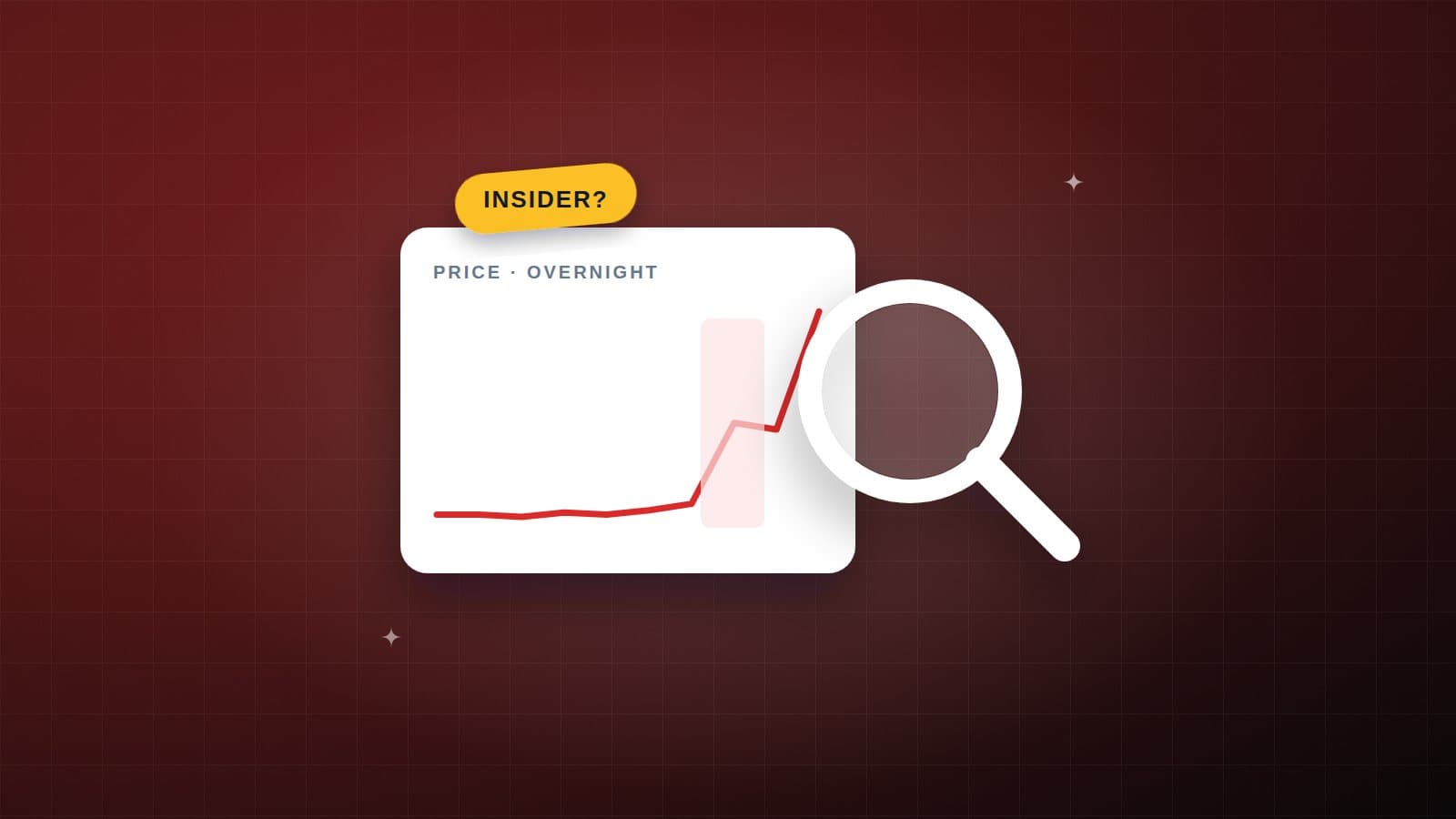
The price edged up from about 6% to 11% overnight, before the operation was public, then jumped to around 48% as reports of strikes in Caracas spread, and passed 99% once President Trump announced Maduro's capture that morning. Moves like the overnight drift are exactly what surveillance teams look for: buying that runs ahead of the news.
In April the Justice Department charged a US Army special forces soldier, reported to be a master sergeant, with using classified information about the operation to bet on Polymarket. According to reports of the case, about $33,000 of bets paid out more than $400,000. It was described as the first criminal insider-trading case involving a prediction market. In March, more than 40 members of Congress had already written to the CFTC and the Office of Government Ethics asking them to warn federal employees, citing a Polymarket user who made nearly $410,000 on Maduro's capture.
The scale: how many cases?
Source: Reporting by The New York Times, as relayed by Gambling Insider and ON360 (August 2026); figures are lower bounds
Show the dataHide the data
| Value | |
|---|---|
| Polymarket referrals | 90 |
| Kalshi referrals | 50 |
| CFTC civil charges | 3 |
The gap between the bars is the story. The platforms are finding and reporting suspects; the regulator is bringing very few cases. The CFTC has been run by a single commissioner, Chairman Michael Selig, and its enforcement staff has shrunk, according to that reporting. In July Senator Elizabeth Warren asked the Government Accountability Office to investigate whether the agency can police these markets.
Kalshi's own numbers for the first quarter of 2026 show how much screening happens before anything reaches a regulator:
Source: Kalshi, as reported by Al Jazeera, June 2026
Why insiders are drawn to prediction markets
A binary contract is a powerful tool for someone who knows the answer. Buying at 8¢ something you know will pay $1 is a twelvefold return in hours, with no options chain, no leverage account and, on a crypto exchange, no name attached. The Maduro numbers fit that pattern: about $33,000 turning into more than $400,000 implies an average price of roughly 8¢, right where the market traded in the hours before the operation.
The damage falls on everyone else. Market makers who get picked off by insiders widen their spreads or pull out, which makes prices worse for ordinary traders, and a market known to be full of insiders stops being a useful forecast. That is why the exchanges, not just regulators, have an interest in catching them.
There is a long-running academic argument on the other side: some economists have argued that insiders make prediction markets more accurate, because their trades push prices towards the truth sooner. Regulated exchanges reject that trade-off. A market that rewards leaking classified plans, or a candidate betting on their own defeat, has costs no accuracy gain can justify.
What counts as insider trading on a prediction market?
On the stock market, insider trading usually means trading on confidential company information. Prediction markets are broader, because the "company" can be a government, a campaign, a film studio or one person:
- Misappropriated information. Trading on information you have a duty to keep confidential, such as an employer's data, an unannounced product or classified government plans. Federal commodities law and CFTC anti-fraud rules cover this on regulated exchanges.
- Controlling the outcome. Betting on something you can decide: a candidate on their own race, a speaker on what they will say, an athlete on their own performance. Exchanges ban this outright, and it can amount to manipulation. Santos was charged with market manipulation rather than insider trading for that reason.
- Tipping. Passing inside information to someone else who trades.
The riskiest markets are those decided by a handful of people: mention markets ("what will Trump say at his rally?"; see mention markets explained), award winners chosen by a small jury, product launch dates, corporate earnings-call words, and narrow political events such as endorsements. CNN reported in October that such specific midterm markets had drawn more than $20 million (midterm trading volume).
What the law says
- Fraud and manipulation. On a CFTC-regulated exchange, the Commodity Exchange Act and the CFTC's anti-fraud rule (Rule 180.1, adopted after the 2010 Dodd-Frank Act) prohibit manipulation and trading on misappropriated information, the theory used against people who trade on an employer's secrets.
- Government information. Dodd-Frank also added what is often called the "Eddie Murphy rule", named after the film Trading Places, which bars trading on non-public information taken from the federal government. Classified military plans are the extreme case.
- Criminal law. Prosecutors can also bring criminal charges, such as wire fraud; the Maduro and Google cases were both brought by the Justice Department.
- Exchange rules. Kalshi and Polymarket ban insider trading and outcome manipulation in their terms, and can freeze accounts and confiscate winnings without waiting for a regulator.
How these rules apply to every kind of event contract has not been fully tested in court, which is part of why Congress wants to legislate.
How Kalshi polices it
- Identity checks on every account, so trades can be tied to real people and their jobs.
- Banned lists: athletes, team staff and others cannot trade markets they can influence. Giannis Antetokounmpo, a Kalshi shareholder, cannot trade any NBA market (Giannis and Kalshi).
- An Independent Surveillance Audit Committee, set up in February 2026.
- Job details for high-risk markets: since June 2026 Kalshi collects employment information from some users before they trade markets it rates at heightened risk, scores markets by manipulation risk, and runs a 24/7 whistleblower channel. Robert DeNault, its head of enforcement, said the measures help Kalshi "continue to lead the industry on the issue of market integrity".
- Transparency for election markets: in October 2026 Kalshi added accuracy scores, low-volume warnings and live trade displays to midterm markets (the new features).
How Polymarket polices it
Polymarket's global exchange runs on a blockchain, which cuts both ways. Accounts are crypto wallets rather than verified identities, so it is harder to know who a trader is. But every trade is public, so journalists, researchers and other traders can spot suspicious wallets in real time; whale trackers exist precisely for that (Polymarket whale tracker). Polymarket says it has referred more than 90 account holders to authorities in the US and abroad. Its regulated US exchange requires identity verification like Kalshi's (how Polymarket works).
What Congress and regulators want
| When | What happened |
|---|---|
| March 2026 | More than 40 lawmakers ask the CFTC and the Office of Government Ethics to warn federal employees about trading on prediction markets |
| 22 May 2026 | House Oversight Committee Chairman James Comer opens an investigation into insider trading on Kalshi and Polymarket |
| 2026 | Lawmakers introduce the Public Integrity in Financial Prediction Markets Act, which would bar elected officials, congressional staff and executive-branch employees from trading certain contracts |
| July 2026 | Senator Elizabeth Warren asks the GAO to examine the CFTC's capacity to police the markets |
| October 2026 | The CFTC proposes defining sports, political, culture and weather contracts as swaps under its exclusive jurisdiction (the proposal) |
The leagues are pushing too. In its Supreme Court brief, the NFL warned about contracts a single player could influence and noted the CFTC has about 543 employees to police these markets (the NFL's brief).
What it means for regular traders
- Be careful in tiny markets. If a few thousand dollars decide the price and a handful of people know the answer, you may be trading against one of them. Check volume and the spread before you buy (slippage, volume and spread).
- Treat sudden moves before news as information. A thin market jumping for no public reason is a warning, not an opportunity.
- Never trade on something you can influence or were told in confidence. Platforms ban it, accounts get frozen, and in the worst cases it is a federal crime.
- Prefer markets decided by many people. Elections, economic data and big games are far harder to rig than a speech or an award.
- Report what looks wrong. Kalshi runs a whistleblower channel; Polymarket's trades are public for anyone to check.
How accurate prices are when insiders are around is its own question: how accurate are prediction markets?.
Insider trading on prediction markets: frequently asked questions
Is insider trading illegal on Kalshi and Polymarket?
On CFTC-regulated exchanges, trading on misappropriated confidential information or manipulating a market is illegal under federal commodities law, and both platforms ban it in their rules. Prosecutors have also charged cases on Polymarket's global exchange.
What happened with the Maduro bet?
In April 2026 the Justice Department charged a US Army special forces soldier with using classified information about the operation to capture Nicolás Maduro to bet on Polymarket; reports say about $33,000 of bets paid out more than $400,000.
Why was George Santos fined?
He bet on Kalshi on whether he would attend the 2026 State of the Union, something he controlled. Kalshi referred him to authorities, and he was fined $35,000.
Can politicians bet on prediction markets?
Candidates cannot bet on their own races on Kalshi, which suspended four in 2026. A bill in Congress would bar elected officials, staff and executive-branch employees from trading certain contracts.
Do insiders make prediction markets more accurate?
Possibly, in a narrow sense, but regulated exchanges ban insider trading because the harm to other traders and to public trust outweighs any gain in accuracy.
What is the "Eddie Murphy rule"?
A provision added by the 2010 Dodd-Frank Act that bars trading commodities and derivatives on non-public information misappropriated from the federal government.
How do Kalshi and Polymarket catch insider trading?
Kalshi verifies every account, screens high-risk markets, collects job details and refers cases to the CFTC. Polymarket's trades are public on the blockchain, and it refers suspicious accounts to authorities.