What does slippage mean on Kalshi? Slippage, volume, spread and open interest explained
The numbers on a prediction market ticket, in plain English: what slippage is and how to avoid it, what volume and open interest mean on Kalshi and Polymarket, and how to read the spread.
In this article
Slippage is the difference between the price you expected to pay and the average price you actually paid. On Kalshi and Polymarket it happens when your order is bigger than what is available at the best price, so it fills partly at worse prices further down the order book. It is the most common hidden cost in prediction markets, and the easiest to avoid once you can read a market.
This guide covers slippage and the other numbers you see on every market: the spread, volume, open interest and liquidity.
Price, bid and ask
A contract's price is the market's probability: 62¢ means the market thinks there is about a 62% chance (why, in how do prediction markets work). In practice there are two prices:
- Bid: the highest price someone is willing to pay right now. You get it when you sell.
- Ask: the lowest price someone is willing to sell at. You pay it when you buy.
The spread
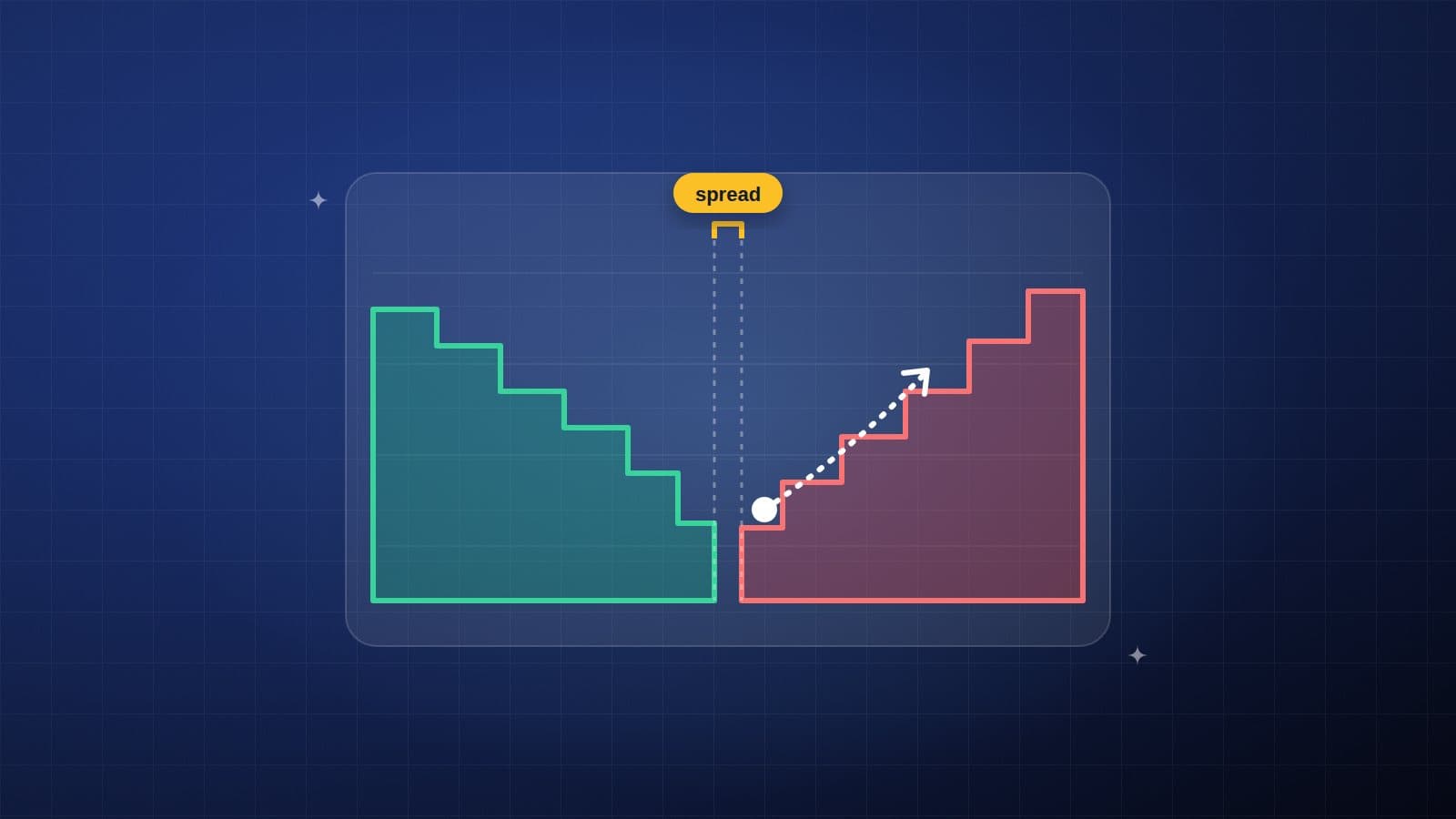
The spread is ask minus bid. If Yes has a bid of 60¢ and an ask of 63¢, the spread is 3¢. Buying and immediately selling would cost you that 3¢ per contract, before fees.
A tight spread (1¢) means an active market with lots of traders. A wide one (5¢ or more) means a thin market: be careful with size, and consider a limit order between the two prices.
What is slippage? An example
Say the Yes side of a market has these sell orders waiting:
| Price | Contracts available |
|---|---|
| 52¢ | 100 |
| 53¢ | 200 |
| 55¢ | 200 |
You place a market order for 500 contracts, expecting to pay 52¢. The order fills 100 at 52¢, 200 at 53¢ and 200 at 55¢: an average of 53.6¢. The 1.6¢ difference, about $8 on this order, is slippage. It is on top of the trading fee (see Polymarket fees vs Kalshi fees).
How to avoid slippage
- Use limit orders. A limit order fills only at your price or better. If not enough contracts are available, the rest waits on the book instead of filling at worse prices.
- Check the depth first. The order book shows how many contracts sit at each price. If your order is bigger than the first level or two, expect slippage.
- Split large orders. Buy in pieces and let other traders refill the book.
- Avoid the moment the news breaks. Spreads widen and books thin out right after big news, exactly when people rush to trade.
- Prefer liquid markets for size. A market with heavy daily volume absorbs large orders far better than a niche one.
When you place an order in the Kalshi app, the ticket shows the estimated cost before you confirm; compare that average price with the price you saw on the market to spot slippage before it happens.
What does volume mean on Kalshi?
Volume is how much has traded. On Kalshi it is counted in contracts, each with a $1 face value, so 50,000 contracts of volume is not the same as $50,000 changing hands (a contract bought at 20¢ costs 20¢). On Polymarket volume is counted in dollars (pUSD, its USDC-backed token). You will usually see two figures:
- 24-hour volume: how active the market is right now. This is what matters for getting good fills.
- Total volume: everything traded since the market opened. A big total on a quiet market means interest was high in the past.
Because the units differ, compare volume within a platform, not between Kalshi and Polymarket. Our live markets page shows each platform's volume in its own unit.
Open interest
Open interest is the number of contracts currently held, not yet sold or settled. Volume counts every trade; open interest counts positions still open. Rising open interest means new money is coming in; falling open interest means traders are closing out.
Liquidity
Liquidity is how easily you can trade without moving the price: tight spread, deep order book, steady volume. Liquid markets have little slippage. On both platforms, the busiest markets (big elections, Fed decisions, major games) are the most liquid; niche questions can have only a few hundred dollars on the book.
Market vs limit orders, maker vs taker
- A market order (or a buy at the current ask) takes liquidity: it fills immediately and pays the taker fee.
- A limit order that rests on the book adds liquidity: you are the maker, and makers pay lower fees (or none, and earn rebates, on Polymarket's global site).
Patient traders who post limit orders pay less in both slippage and fees.
Slippage and volume: frequently asked questions
What does slippage mean on Kalshi?
The gap between the price you expected and the average price you paid, caused by an order larger than what was available at the best price. Limit orders prevent it.
What does volume mean on Kalshi?
The number of contracts traded, each worth $1 at settlement, over 24 hours or since the market opened.
What is a good spread on a prediction market?
1–2¢ is tight. Above 5¢, use limit orders and smaller size.
Is open interest the same as volume?
No. Volume counts trades; open interest counts contracts still held.
Does Polymarket have slippage too?
Yes, any order book does. The same rules apply: check depth, use limit orders, split big orders.