How to calculate expected value on Kalshi and Polymarket (EV formula and examples)
Expected value tells you whether a trade pays on average. The EV formula for prediction market contracts, worked examples with fees, break-even probability, annualised returns, and the mistakes that turn +EV into losses.
In this article
Expected value (EV) is what a trade is worth on average if you could make it many times. On a prediction market the formula is short: if you buy a contract at price c and you think the true chance is p, your expected profit per contract is p − c − fees. Positive means the trade pays over time; negative means it costs you.
This guide shows the formula, works through examples with real fee schedules, and covers the mistakes that make a "+EV" trade lose money. To run your own numbers, use our expected value calculator.
The expected value formula
In general, expected value is the sum of each outcome's value times its probability:
EV = Σ (probability of outcome × what you gain or lose in that outcome)
A prediction market contract pays $1 if it happens and $0 if it does not. If you pay c for it:
- With probability p you gain 1 − c.
- With probability 1 − p you lose c.
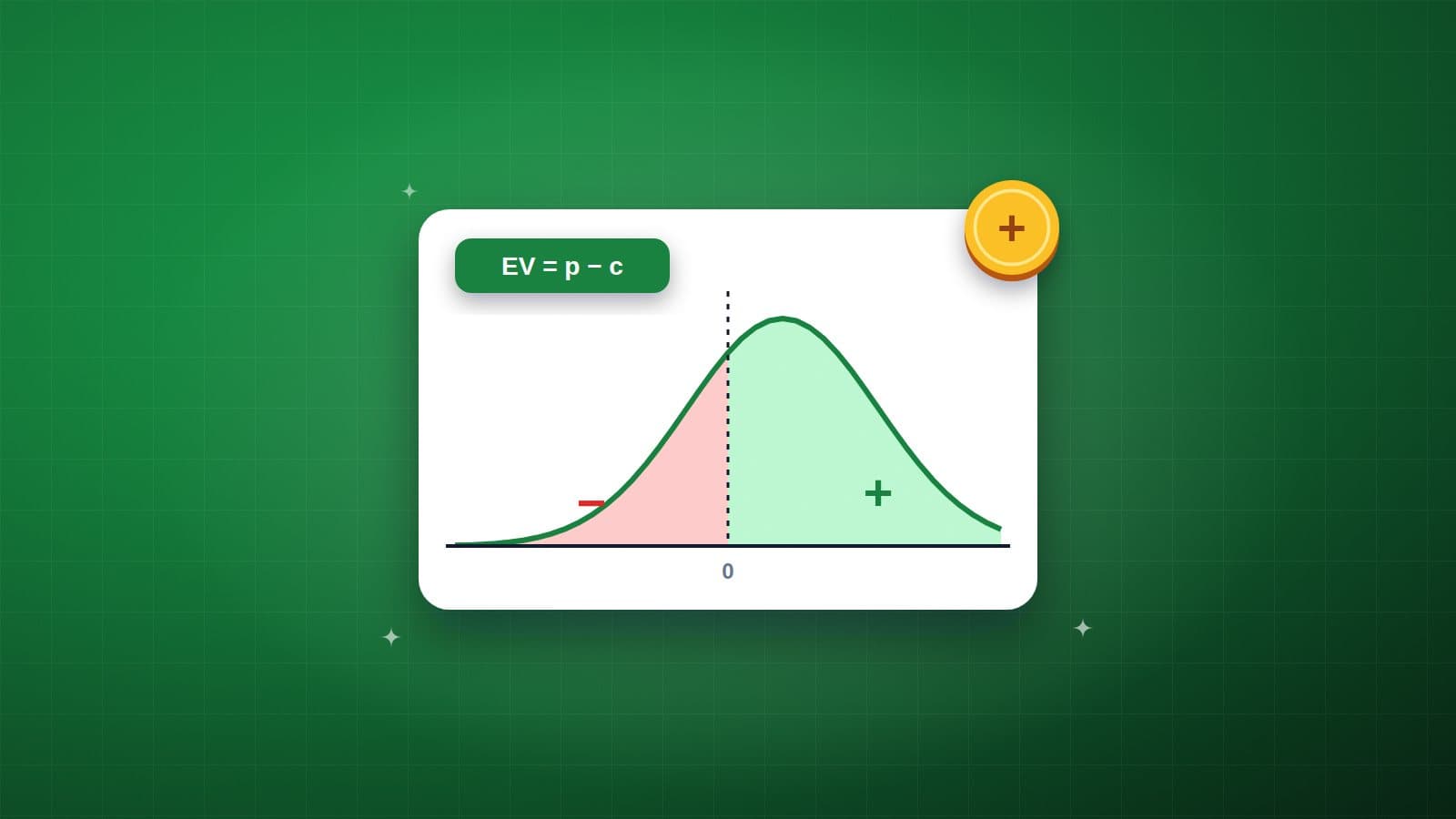
EV = p × (1 − c) − (1 − p) × c = p − c
Then subtract the fee you pay to trade. That is the whole formula: your probability minus the price minus fees.
Worked example on Kalshi
A contract trades at 40¢ and you think the true chance is 50%.
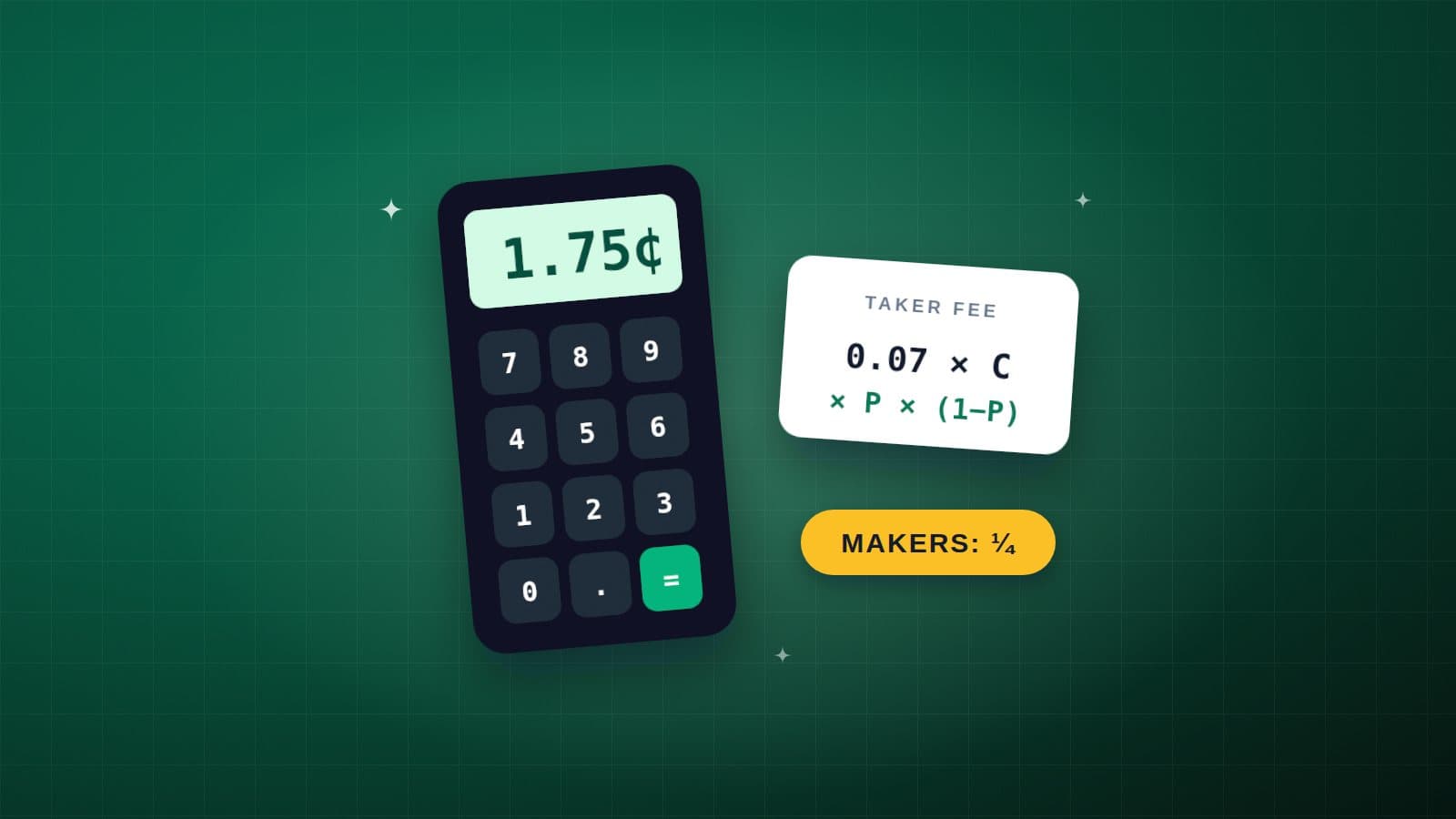
- Kalshi taker fee: 7% × 0.40 × 0.60 = about 1.7¢ per contract.
- EV = 0.50 − 0.40 − 0.017 = +8.3¢ per contract.
- On 100 contracts ($41.70 all in) that is about +$8.30 expected, a return of about 20% on the money at risk.
If you thought the chance was only 41%, EV would be 0.41 − 0.40 − 0.017 = −0.7¢: a losing trade, even though your estimate is above the price.
Break-even probability
Turn the formula around to get the probability you need just to break even:
break-even probability = price + fee per contract
| Price | Kalshi taker fee | You need to be right more than |
|---|---|---|
| 10¢ | 0.6¢ | 10.6% |
| 25¢ | 1.3¢ | 26.3% |
| 50¢ | 1.75¢ | 51.75% |
| 75¢ | 1.3¢ | 76.3% |
| 90¢ | 0.6¢ | 90.6% |
On Polymarket replace 7% with the category rate (lower in most categories, and zero for world-events markets), and if you post a limit order as a maker, your fee is zero. Details: Polymarket fees vs Kalshi fees.
Expected value of buying "No"
Buying "No" at price n is the same calculation with the probability of "No":
EV(No) = (1 − p) − n − fees
If "Yes" is 70¢ and "No" is 31¢ (the extra cent is the spread), and you think "Yes" has only a 60% chance, then EV(No) = 0.40 − 0.31 = +9¢ before fees, and about +7.5¢ after Kalshi's taker fee of about 1.5¢ at that price.
EV as a return, and over time
A 95¢ contract on something you are sure about has EV = 1 − 0.95 = 5¢, a 5.3% return. Whether that is good depends on how long your money is locked up:
- Resolving next week: 5.3% in a week is excellent.
- Resolving in six months: about 10.8% a year, compared with roughly 3–4% you could earn on cash.
- Resolving in two years: about 2.6% a year, worse than a savings account.
Annualised return = (1 / price)^(365 / days to resolution) − 1, ignoring fees. Kalshi pays interest on eligible balances and positions, and Polymarket pays holding rewards on some long-dated markets, which changes the sums for long trades.
Where does your probability come from?
EV is only as good as your estimate of p. Common sources:
- Your own model: polls, statistics, base rates (how often things like this happen).
- Another market: if Kalshi prices an outcome at 48% and Polymarket at 41%, the gap is a clue. Remove the overround from multi-outcome markets before comparing (how to read odds).
- Expert consensus: for economic data, the economists' forecast is the starting point.
If you cannot say why your probability is better than the market's, the honest assumption is that the market is right and your EV is negative by the size of the fee.
Positive EV is not guaranteed profit
EV is an average. A +8¢ trade at 40¢ still loses its whole stake half the time if your 50% estimate is right. Over 10 such trades, losing money is quite possible; over 200, a real edge shows up. That is why sizing matters as much as finding edges: betting too much on one +EV trade can wipe you out before the average arrives. How much to bet: the Kelly criterion.
Mistakes that turn +EV into losses
- Using the midpoint instead of the price you pay. Your cost is the ask (plus slippage on bigger orders): slippage and spread.
- Forgetting fees, especially around 50¢ where they are highest.
- Ignoring time. A small edge on a long-dated market can be worse than holding cash.
- Overconfidence. Most people's 90% calls come true less often than 90%. Score yourself: Brier score.
- Ignoring the rules. You are betting on how the market resolves, not on what you think "really" happened: how markets resolve.
Expected value: frequently asked questions
What is +EV betting?
Placing only trades where your estimated probability is higher than the price plus fees, so that the average result is a profit.
How do I calculate the EV of a Kalshi contract?
Your probability minus the price minus the fee per contract. At 40¢ with a 50% estimate: 0.50 − 0.40 − 0.017 = +8.3¢.
Is a positive EV trade a sure win?
No. It wins on average over many trades, and individual trades still lose often.
What is a good expected value?
Any positive EV after fees is an edge. Compare the return with how long your money is tied up.