The Kelly criterion for prediction markets: how much to bet on Kalshi and Polymarket
Kelly sizing tells you what share of your bankroll to put on a trade with an edge. The formula for a $1 contract, worked examples, why most traders use half Kelly, and the mistakes that make Kelly dangerous.
In this article
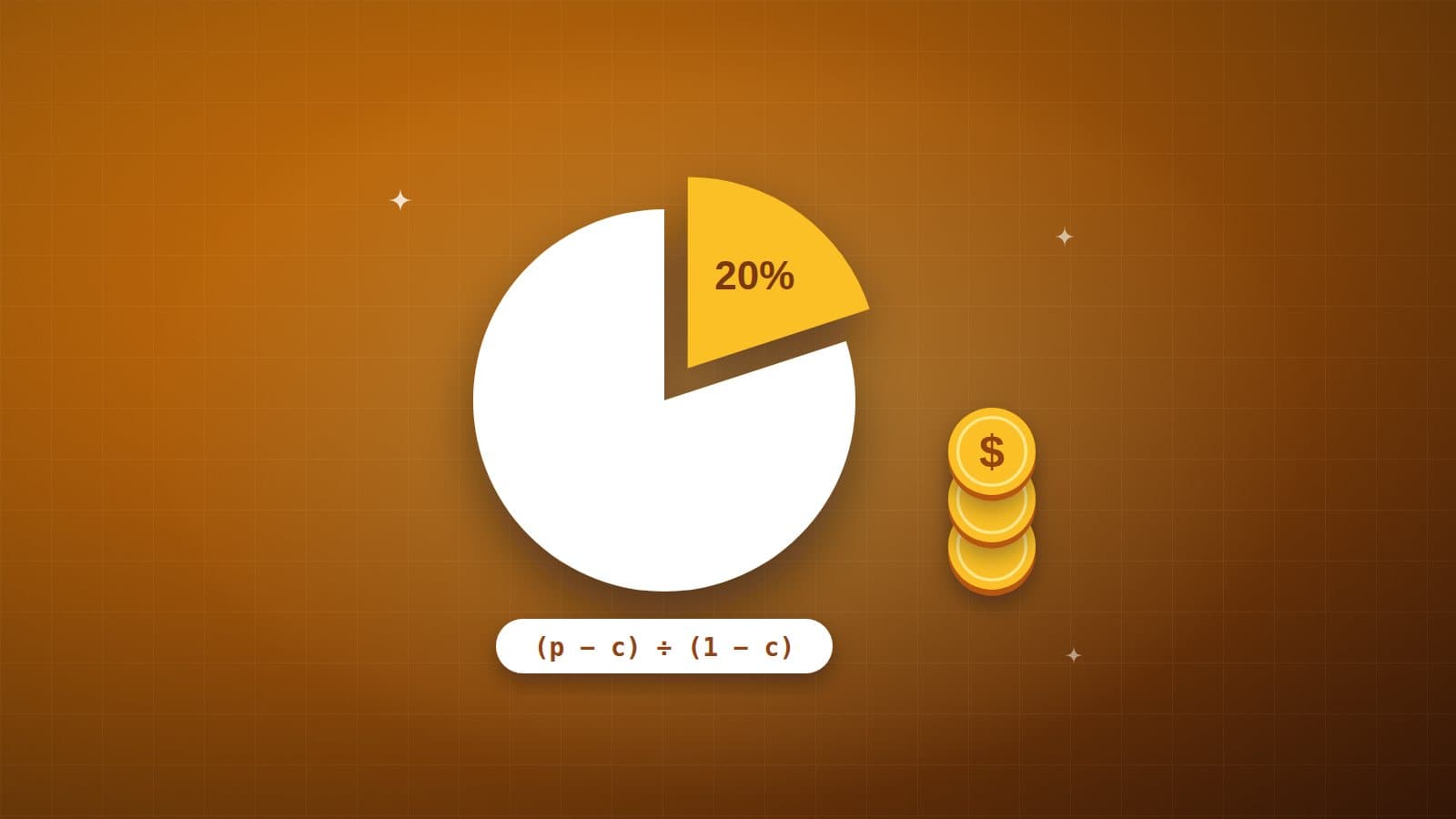
The Kelly criterion answers the question every trader faces after finding an edge: how much should I bet? It gives the share of your bankroll that makes your money grow fastest over many bets. On a prediction market contract bought at price c with your estimated probability p, the Kelly fraction is:
Kelly fraction = (p − c) ÷ (1 − c)
Bet more than that and you grow more slowly while taking more risk; bet much more and you are likely to go broke even with a real edge. Our Kelly criterion calculator does the sums for you, fees included.
Where the formula comes from
John L. Kelly Jr., a scientist at Bell Labs, published the idea in 1956 while studying information sent over noisy telephone lines. The mathematician Edward Thorp then used it to size blackjack bets and later investments. The classic version for a bet that pays b to 1 is:
f = (b × p − q) ÷ b, where q = 1 − p.
A prediction market contract bought at c pays (1 − c) of profit for every c you risk, so b = (1 − c) ÷ c. Substituting gives the simple form above: (p − c) ÷ (1 − c).
Worked examples
| Price (c) | Your probability (p) | Edge (p − c) | Kelly: share of bankroll |
|---|---|---|---|
| 50¢ | 55% | 5 points | 10% |
| 50¢ | 60% | 10 points | 20% |
| 20¢ | 30% | 10 points | 12.5% |
| 80¢ | 85% | 5 points | 25% |
| 90¢ | 93% | 3 points | 30% |
| 40¢ | 38% | −2 points | 0% (do not bet) |
With a $1,000 bankroll, a 50¢ contract you think is 60% likely gets $200, or 400 contracts. Note how expensive contracts get large Kelly fractions even for small edges: you risk 90¢ to win 10¢, but you lose rarely, so Kelly is happy to bet big. That is exactly where an overconfident estimate does the most harm.
Betting on "No"
To buy "No" at (1 − c) because you think "Yes" is overpriced, use the probability of "No":
Kelly fraction for No = (c − p) ÷ c
If "Yes" trades at 30¢ and you think its chance is 20%, Kelly says to put (0.30 − 0.20) ÷ 0.30 ≈ 33% of your bankroll on "No" at 70¢.
Include fees in the price
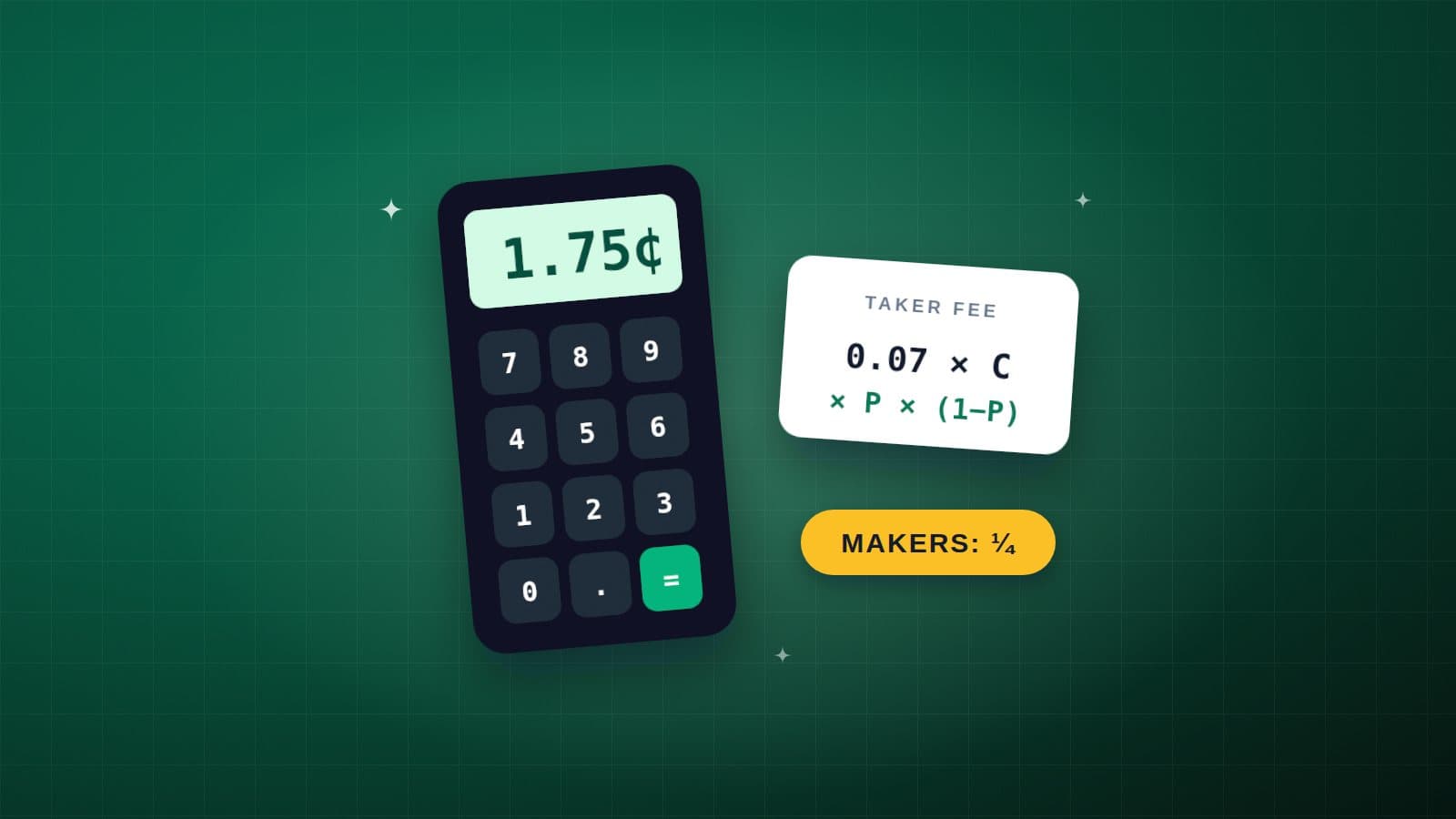
Fees raise your real cost. Replace c with c + fee per contract before applying the formula. At 50¢ on Kalshi the taker fee is about 1.75¢, so a 55% estimate gives (0.55 − 0.5175) ÷ (1 − 0.5175) ≈ 6.7% instead of 10%. Small edges shrink fast after fees (fees compared).
Why most traders use half Kelly
Full Kelly assumes your probability is exactly right. It never is. Betting a fraction of Kelly is the standard fix:
| Share of Kelly you bet | Long-run growth vs full Kelly | Swings in your bankroll |
|---|---|---|
| 25% | about 44% | a quarter |
| 50% | about 75% | half |
| 100% | 100% | full |
| 200% | about 0% | double |
Half Kelly keeps about three-quarters of the growth with half the volatility. And the last row is the warning: betting twice the Kelly amount gives you roughly zero long-run growth for all that risk. Because you will sometimes overestimate your edge, betting less than Kelly is the safer mistake.
Kelly across many markets at once
The simple formula is for one bet at a time. In practice you hold several positions, and they are often linked: if you are long Democrats in ten Senate races, a national swing hits all ten together. Treat correlated positions as one bigger bet, and cap the total you have riding on any single theme. A common rule of thumb is to keep the sum of all open Kelly-sized positions below your bankroll and well below it when they are correlated.
Limits of the Kelly criterion
- Garbage in, garbage out: Kelly multiplies your confidence. Score your forecasts first (Brier score).
- Liquidity: on a thin market you cannot buy your full Kelly size without moving the price against you (slippage).
- Time: Kelly ignores how long money is locked up. A 30% Kelly bet on a market resolving in two years ties up capital you could use elsewhere.
- It maximises long-run growth, not comfort: even full Kelly with a true edge has deep drawdowns.
A quick Kelly routine
- Write down your probability p before looking hard at the price.
- Add the fee to the price: c + fee.
- Compute (p − c) ÷ (1 − c). If it is zero or negative, skip the trade.
- Bet a quarter to a half of that share of your bankroll.
- Record the trade and score your forecast when it resolves.
Kelly criterion: frequently asked questions
What is the Kelly formula for prediction markets?
(p − c) ÷ (1 − c): your probability minus the price, divided by one minus the price.
Should I use full Kelly?
Most experienced traders use a quarter to a half. Full Kelly is only right if your probability estimates are exact.
What if the Kelly number is negative?
There is no edge on that side. Either skip the trade or check whether the other side ("No") has one.
Does Kelly work for sports betting too?
Yes, with b equal to the decimal odds minus one. The same caution about estimates applies.