Polymarket rewards explained: liquidity rewards, holding rewards and maker rebates (2026)
Polymarket pays traders in three ways besides winning trades: daily liquidity rewards for resting limit orders near the midpoint, 3.25% annualised holding rewards on 18 long-dated markets, and maker rebates funded by taker fees. How each works, the formulas, worked examples and what they are really worth.
In this article
Polymarket pays you for more than being right. On the global site, three programs pay out every day: liquidity rewards for limit orders that rest close to the market price, holding rewards of 3.25% a year on positions in selected long-dated markets, and maker rebates, a share of the taker fees your filled orders generate. A fourth, the referral program, pays for bringing in new traders.
As of 23 October 2026, from Polymarket's documentation and help centre. Polymarket can change rates, caps and eligible markets at any time.
Polymarket rewards at a glance
| Program | What you do | How it is paid | Best for |
|---|---|---|---|
| Liquidity rewards | Rest limit orders near the midpoint, above a minimum size | Daily at midnight UTC; $1 minimum | Market makers and patient limit traders |
| Holding rewards | Hold Yes or No shares in eligible markets | Sampled hourly, paid daily | Long-term holders |
| Maker rebates | Have your resting orders filled | Daily in pUSD; $1 minimum | Active makers |
| Referral rewards | Refer new traders | Daily at midnight UTC in pUSD | Traders with $10,000+ volume |
Liquidity rewards
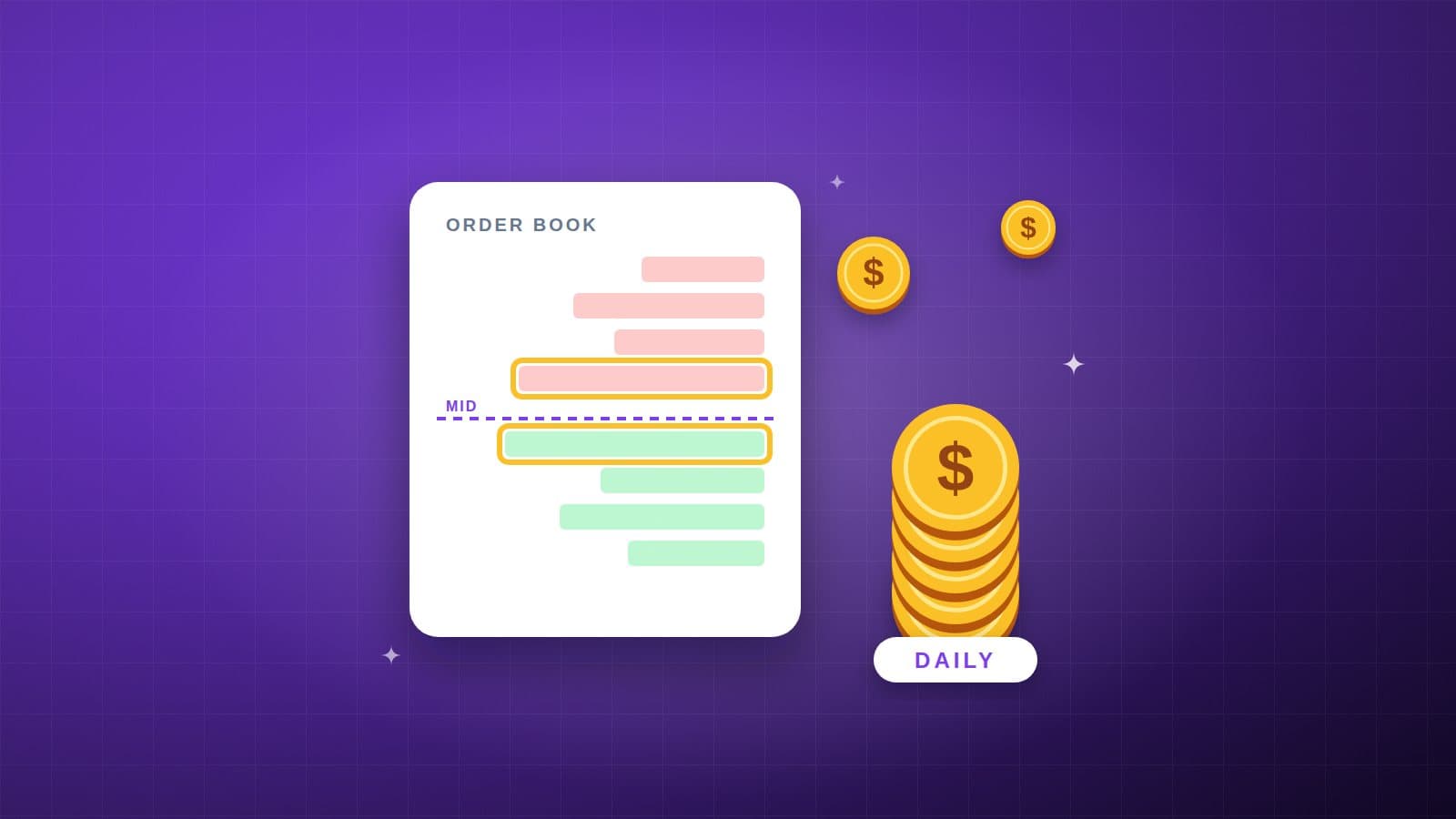
Polymarket wants tight, deep order books, so it pays people to provide them. Each eligible market has a daily reward pool and two settings, shown on the market and in the API: a minimum order size and a maximum spread, in cents from the midpoint. Orders that meet both earn a score; your share of the pool is your score divided by everyone's. Your order does not need to fill to earn.
How an order is scored
The score falls with the square of the distance from the midpoint:
Score = ((max spread − your distance) ÷ max spread)² × size
So with a 3¢ maximum spread, an order 1¢ from the midpoint scores 44% of an order sitting on it, and one 2¢ away only 11%.
Source: Polymarket liquidity rewards formula
Show the dataHide the data
| Value | |
|---|---|
| 0¢ | 100% |
| 0.5¢ | 69% |
| 1¢ | 44% |
| 1.5¢ | 25% |
| 2¢ | 11% |
| 2.5¢ | 3% |
| 3¢ | 0% |
The rules that trip people up
- Two sides beat one. When the midpoint is between 10¢ and 90¢, an order on one side only still counts, but at a third of its score; quotes on both sides earn the full amount. Below 10¢ or above 90¢, you must quote both sides to earn anything.
- The book is sampled once a minute at a random moment, up to 1,440 times a day. Pulling orders at the wrong moment costs you samples.
- Rewards are paid daily at midnight UTC, and amounts under $1 are not paid.
- Special programs end. A separate rewards program for 5-minute, 15-minute and 4-hour crypto markets has ended.
The catch
A resting order near the midpoint is exactly the order that gets filled when news breaks against you. Market makers call it adverse selection, and on a fast-moving market it can cost more than a day's rewards. Liquidity rewards work best on slow markets you understand, with orders on both sides (limit order vs market order).
Holding rewards
Holding rewards pay interest-like income on positions in long-dated markets, so money parked for a year or more is not dead money.
- Rate: 3.25% a year, variable, down from 4% when the program launched in 2025. Polymarket can change it or cap total payouts.
- What counts: the value of your Yes and No shares, each at the latest midpoint price.
- How it is paid: your position value is sampled at a random moment each hour, and rewards are paid daily, funded by Polymarket's treasury.
- Which markets: 18 eligible events, including the 2028 presidential election winner and nominee markets, 2026 midterms balance of power, Senate and House, leaders out before 2027 (Erdoğan, Zelenskyy, Netanyahu, Xi, Putin), a Russia–Ukraine ceasefire before 2027, and 2026 price targets for Bitcoin, Ether, HYPE, Solana and XRP.
Worked example (Polymarket's own): 30,000 Yes shares at 53¢ and 10,000 No shares at 45¢ are worth $20,400. At 3.25% that earns about $0.076 an hour, $1.82 a day or roughly $663 a year.
Because both sides count, a position hedged with Yes and No still earns. Entering costs the spread and any taker fees, though, and Polymarket says it may limit total payouts, so treat it as a bonus on positions you want rather than free money (how to hedge a bet). Polymarket's help centre also says a new reward and resolution system is planned for later in 2026.
Maker rebates
Taker fees fund a daily rebate pool for the makers whose orders they hit. In each market your share is the fees your filled resting orders would have generated, divided by all makers' total, applied to the pool:
- Crypto: 20% of taker fees; sports: 15%; politics, economics, tech and most other categories: 25%.
- None on fee-free markets such as geopolitics, during fee holidays, or on combos.
- Paid daily in pUSD, with a $1 minimum. Polymarket sets the percentages and can change them.
Polymarket US runs a separate rebate scheme for makers above $10 million of monthly volume (Polymarket fees explained).
Referral rewards
Referrers with $10,000 in lifetime volume earn 10% of the net fees of people they refer directly and 5% from indirect referrals, for up to 30 days per referral. New users get no bonus on the global site (Polymarket promo code).
Polymarket rewards vs Kalshi interest
| Polymarket holding rewards | Kalshi interest | |
|---|---|---|
| Rate | 3.25% a year | 3.50% APY |
| Applies to | Positions in 18 eligible markets | Cash and all open positions |
| Minimum | None stated | $250 average monthly balance |
| Paid | Daily | Monthly |
| Who can get it | Global site users (not the US) | Eligible US users |
Kalshi's version is broader; Polymarket's is limited to the long-dated markets where holding costs bite hardest (Kalshi review).
Are Polymarket rewards an airdrop?
No. They are paid in pUSD, Polymarket's dollar token, not in a new token. There is still no Polymarket token, and sites promising to "check your airdrop" are scams (Polymarket airdrop). In most countries, including the US, rewards are likely to count as income; keep records (how prediction market winnings are taxed).
Polymarket rewards: frequently asked questions
How do Polymarket liquidity rewards work?
Resting limit orders within a market's maximum spread and above its minimum size earn a share of a daily pool, scored by how close they are to the midpoint. They do not need to fill.
When are Polymarket rewards paid?
Liquidity rewards daily at midnight UTC; holding rewards daily, from hourly samples; maker rebates daily in pUSD. Amounts under $1 are not paid.
What is the Polymarket holding rewards rate?
3.25% a year at the time of writing, variable, on 18 eligible long-dated markets.
Do I need to be filled to earn liquidity rewards?
No. Liquidity rewards pay for resting orders; maker rebates pay when they fill.
Are rewards available on Polymarket US?
The programs in this guide are the global site's. Polymarket US has its own maker and taker rebates for high-volume traders.